
Use the tool. Keep the power.
Your experience gives you knowledge the tool does not have. Critical use means keeping responsibility for the decisions, checking the answer, and deciding what belongs in your work.
Sign in with your college account and look for the green shield.

Is that you?
You know where you stand and what it took to get here. Ask the tool to describe a student, then compare.
What to look for. You asked for a typical student, so the tool had to generalize. Compare its answer with your own experience. Notice what fits, what does not fit, and what it could not know unless you chose to share it.
Describe a typical college student. Be specific about their background, their daily schedule, who pays for school, and what they worry about.
Paste it and read what comes back. You do not need to correct it or tell it anything about yourself. Hold it up against your own experience.
Answer in general terms. You never owe a tool the details of your life, and nothing identifying belongs in these boxes.
Answer above, or read it now.
The email you would rather not write.
Same task for everyone. Two ways to ask for help with it. Watch who ends up making the decisions.
What to look for. Both approaches can produce something usable. The difference is whether you decided what the email should ask for and disclose, and whether you checked the result.
The situation
Jordan is in ENGL 102. A five page argument essay is due Friday at 11:59 pm. On Tuesday, Jordan's manager moved the closing shifts to Wednesday and Thursday. Jordan has an outline and two finished pages, and has never asked this professor for anything.
Answer as Jordan, using the details above. This is a fictional student, so you do not need to share anything about yourself.
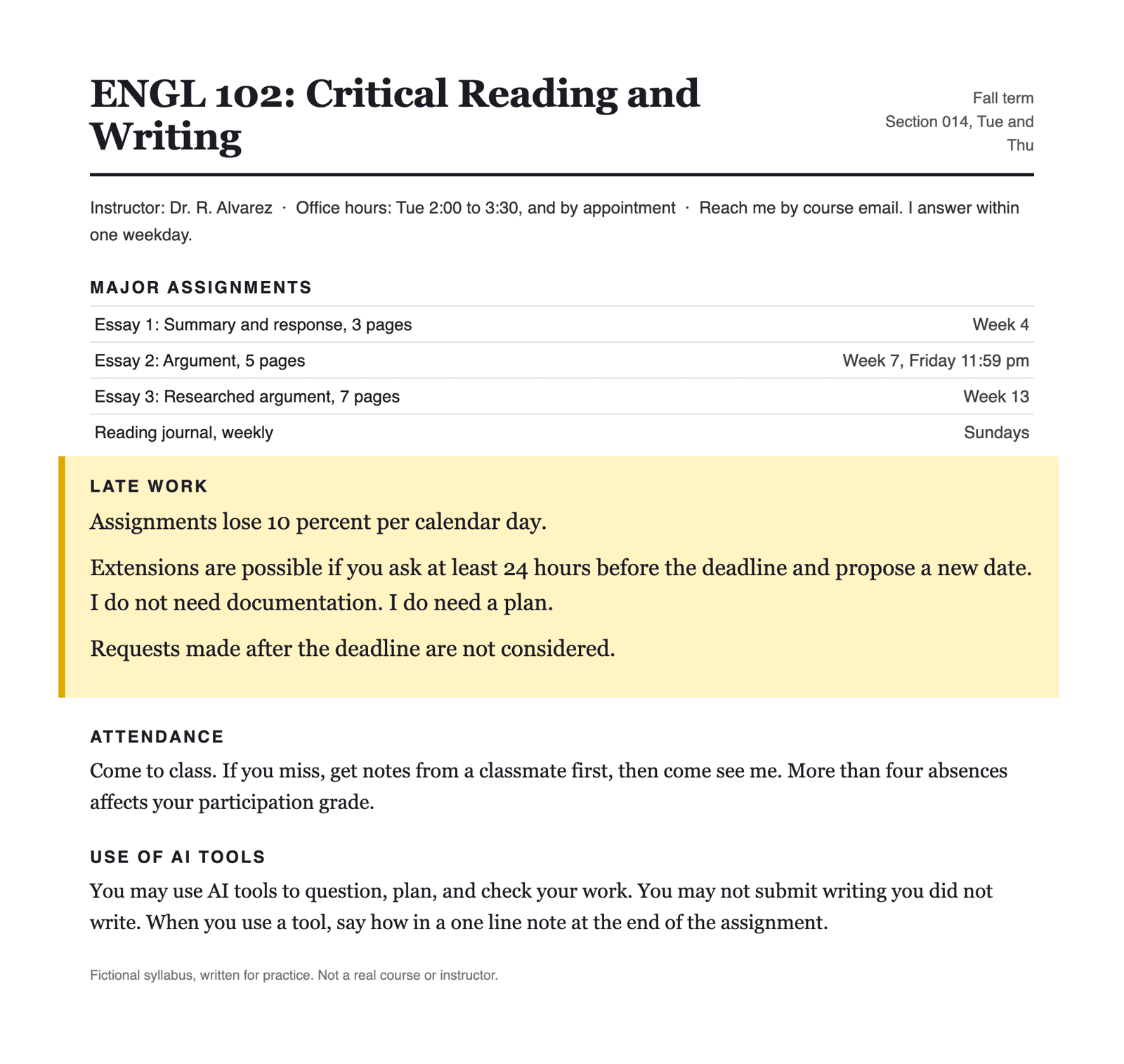
From the syllabus: late work
Assignments lose 10 percent per calendar day. Extensions are possible if you ask at least 24 hours before the deadline and propose a new date. I do not need documentation. I do need a plan. Requests made after the deadline are not considered.
A prompt that leaves the decisions open
Write an email to my professor asking for an extension on my essay.
The prompt may produce a reasonable draft, but the tool has to decide what Jordan should request, what Jordan should disclose, what tone to use, and whether the request fits the syllabus. The problem is not that AI drafted. The problem is that Jordan made none of those decisions first.
A process that keeps the decisions visible
I need to ask my professor for an extension. Do not draft the email yet. Interview me with three questions, one at a time, about my situation, what I have finished, the syllabus policy, and what I am requesting. Wait for each answer. Then give me an outline of the decisions I need to make, including what to say, what may be unnecessary or too private, and what I still need to decide. I may ask you to help draft after I review the outline.
Jordan supplies the context. Jordan decides what to request and disclose. Jordan can compare the suggestions with the syllabus. AI may help draft later, but Jordan still owns the decisions and the final message.
The five parts, in the prompt above
This is why that prompt works. Every part of it is doing one job.
- Role or goal
- I need to ask my professor for an extension.
- Context
- my situation, what I have finished
- Source
- the syllabus policy
- Task
- Interview me with three questions, one at a time
- Format
- an outline of the decisions I need to make
Context and source are the two you supply. They are what make the answer yours, and what make it checkable.

Add one or two power moves.
Tick a move and its sentence joins your prompt. A move changes what you are asking for. It does not guarantee a good answer, so you still review what comes back.
Your prompt
Base prompt
I need to ask my professor for an extension. Do not draft the email yet. Interview me with three questions, one at a time, about my situation, what I have finished, the syllabus policy, and what I am requesting. Wait for each answer. Then give me an outline of the decisions I need to make, including what to say, what may be unnecessary or too private, and what I still need to decide. I may ask you to help draft after I review the outline.
When it asks about the syllabus, paste the late policy. There is a copy button beside it above.
No moves added yet. The base prompt works on its own.
Now review what came back.
Fill in all three before you move on. This is the part of the activity that matters most.
A better prompt can still produce a weak answer. Critical use includes deciding what to keep, what to change, and what to check before you use it.

Critical use, in four parts
- Check whether AI is allowed for the task.
- Decide what thinking and decisions must remain yours.
- Give the tool the context it cannot know.
- Check the result before you use it.
- Uncritical use
- You hand over the decisions.
- You accept the first answer.
- You do not check what matters.
- Critical use
- You decide what the task requires.
- You question the answer.
- You verify before using it.
Critical use is about responsibility, not who typed the first sentence.

What you just did has a name.
You decided what to keep, what to change, and what to check. The name for that kind of judgment is about 2,400 years old.
- Information
- Knowing what is generally true.
- Practical wisdom
- Deciding what fits here, for these people, with these consequences.
Wisdom is knowing what is good and bad for people, and doing something about it.
AI can recommend an action. It cannot take responsibility for the decision.
Your rule for using AI
One sentence, in your own words. It is for you. You do not have to share it.
Before you write your rule
Useful for
- Clarifying an idea you already have
- Organizing something messy
- Comparing options and their trade-offs
- Building an outline or a checklist
- Generating questions to think through
- Practicing a conversation before you have it
Stays yours
- The decision, and what it costs
- What belongs in the work and what does not
- Whether the claim is actually true
- Whether your course allows it
- The final version, in your words
If it edits your writing, use this
Improve only clarity, flow, and organization. Keep my main points and my wording where it already works. After revising, list exactly what you changed and why, so I can review each edit.
A clean draft hides its own edits. Asking for the list turns a rewrite back into something you can approve line by line.
Write the whole sentence with your own words in the blanks. It stays on this device and goes into your guide if you download it.
More prompts like these.
Twelve prompts for real coursework, grouped by the problem you actually have. Check what your course allows before you use one on an assignment, and check what comes back before you rely on it.

Pick the prompts you would actually use.
Save as many or as few as you like. Saved prompts go into your downloaded guide. You can download with none.
No prompts saved.
Nothing saved yet. Use the Save button on any card below.
The library
Grouped by the problem you actually have. Search it, save the ones you want, and open a card when you want the reasoning behind the prompt.
Showing 12 of 12 prompts across 4 groups.
When you do not get it
For the reading you have read three times and still cannot hold.
Explain it three ways
The three levels give you a foothold, and the explain-it-back step is the part that makes it stick.
Find the hole in my understanding
You cannot see your own gap by looking harder at what you already believe.
Interview the expert
The transferable skill is knowing which answers deserve your trust.
Checking what it told you
The habit that separates using AI from believing AI.
AI output autopsy
Finding the wrong answer takes more expertise than writing a right one.
The citation check
Asking a tool to flag its own uncertainty is not proof, but it surfaces the shakiest claims so you know where to look first.
Make it argue against itself
Its first answer follows whatever framing you gave it.
Working on your own draft
Feedback on writing you already did. Never a replacement for doing it.
Find my weakest paragraph
Asking for one problem gets you a real one.
The skeptical reader
You cannot see your own assumptions, because to you they read as obvious.
Draft, interrogate, revise
Draft first, then critique, then revise yourself.
Studying for real
Retrieval practice, which is the studying that actually works.
Quiz me, and do not tell me
Pulling an answer out of your own memory is what builds it.
Turn my notes into questions
It converts material you already gathered into retrieval practice.
Explain why I got it wrong
The valuable information is in the specific way you were wrong, not the correct answer.
Take it with you.
Your responses, your email prompt, your rule, and any prompts you saved, in one page you can keep. Sections you skipped are left out.

No prompts saved. You can still download.
On a shared computer?
On a shared computer, save the guide to your MC OneDrive or another location you control. Then delete the local download and clear what you wrote in this browser before leaving.
Have a few extra minutes? Try a practice scenario. Or the two minute sandwich exercise. Open it here.
Extra practice
Four more situations.
Same five steps every time. Read the situation, read the document, judge a sample answer, write your own prompt, then decide what you would keep, reject, and check.
The sample answers below were written by hand for this activity. They are realistic, not captured from a chat, and each one has problems in it on purpose.
Watch this one first
The scholarship essay
Watch for: an answer that could be about anyone.
The situation
Maya is applying for a scholarship that closes Friday. The application asks for 400 words about a challenge that shaped her. She has never written about herself for something like this, and the deadline is in three days.
The document
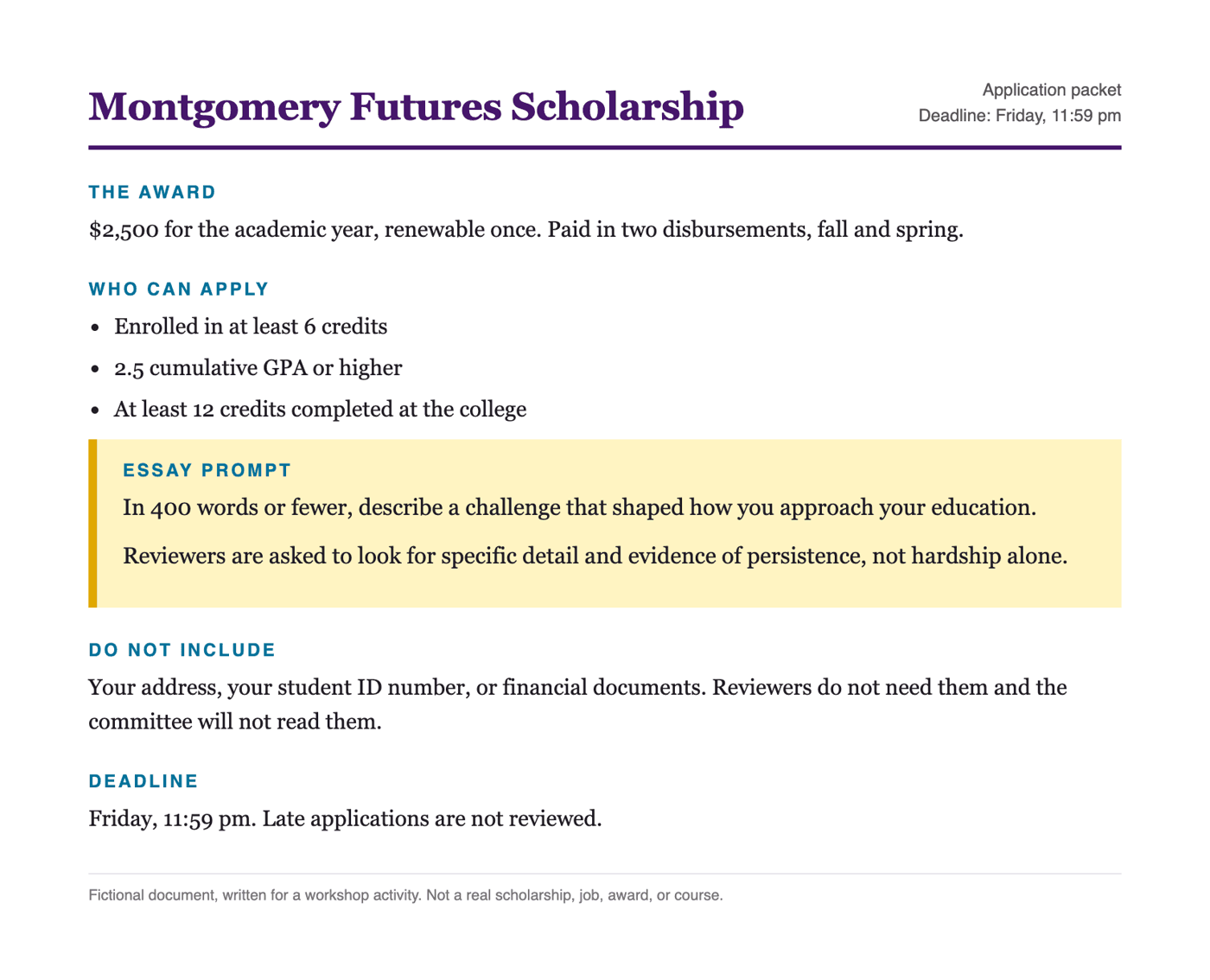
The application page
MONTGOMERY FUTURES SCHOLARSHIP. Award: $2,500 for the academic year, renewable once. Eligibility: enrolled in at least 6 credits, 2.5 GPA or higher, completed at least 12 credits at the college. Essay prompt: In 400 words or fewer, describe a challenge that shaped how you approach your education. Reviewers are asked to look for specific detail and evidence of persistence, not hardship alone. Do not include your address, ID number, or financial documents. Deadline: Friday, 11:59 pm. Late applications are not reviewed.
Judge this answer
Somebody typed this
Write a 400 word scholarship essay about a challenge that shaped me.
And got this back
Throughout my academic journey, I have faced numerous challenges that have shaped me into the resilient student I am today. Coming from a background where higher education was not always accessible, I learned early on that perseverance is the key to success. Despite facing financial hardship and family obligations, I remained committed to my studies and never gave up on my dreams. These experiences taught me the value of hard work and determination, and they continue to motivate me every day. I am confident that this scholarship would allow me to continue pursuing my passion for learning and give back to my community in meaningful ways.
Three problems in it
- It could be about almost anyone. Nothing in it could only be Maya.
- It names hardship but shows no specific detail, which is the one thing the reviewers are told to look for.
- It invented the financial hardship and the family obligations. Maya never said either.
Now pick one
Three situations, three different things to watch for. One is enough. You can come back for the others later.
Pick one above and the rest of the activity opens here.
You will not always have a document to check against. You will always have what you know. That is the part you bring.
Optional extra practice
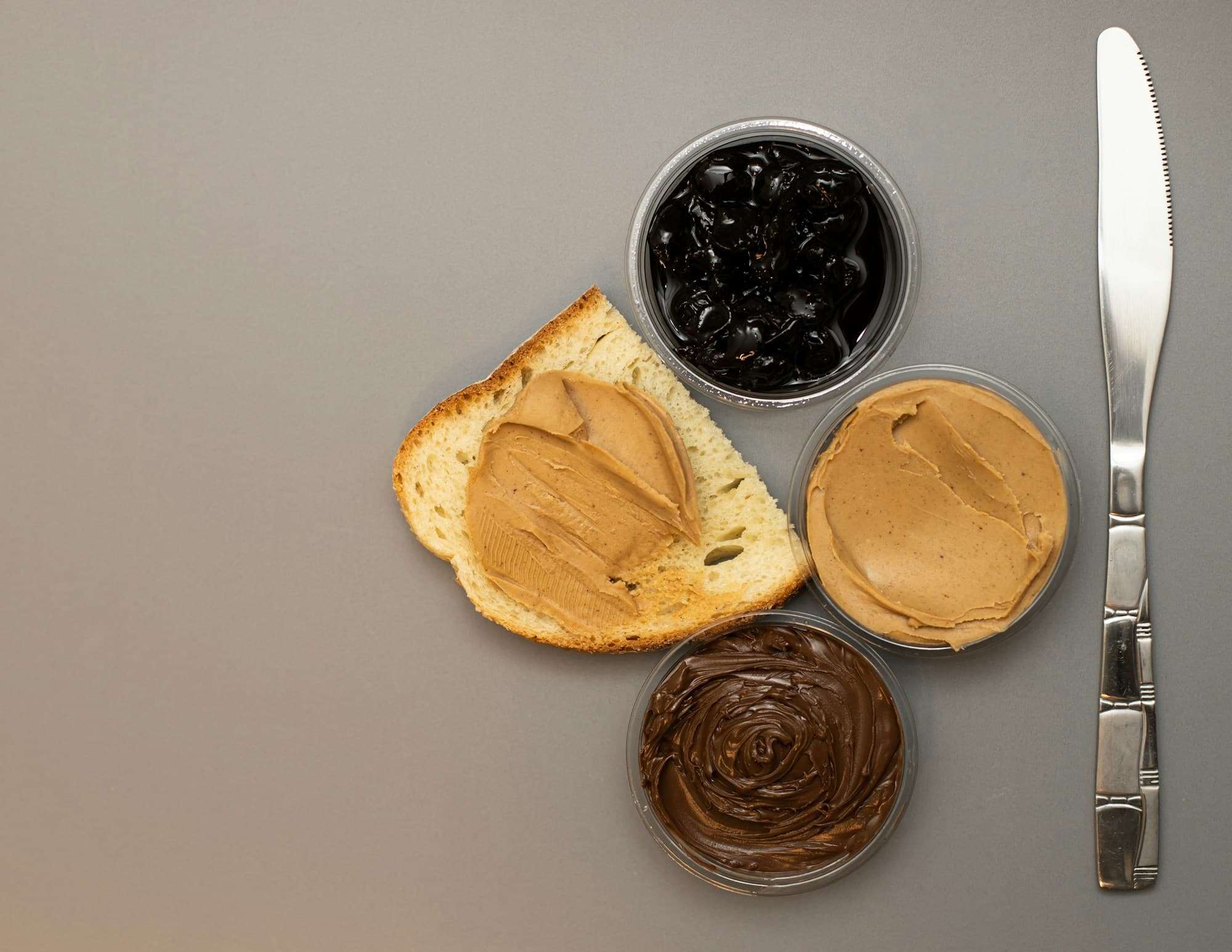
The peanut butter and jelly test.
A two minute exercise for anyone who finishes early, or for later.
Why try it. This quick activity helps you notice how instructions depend on assumptions about the person, tools, setting, and level of detail.
Write instructions for making a peanut butter and jelly sandwich for a five-year-old.
Paste it and read what comes back as if you were the five year old. Then answer the three boxes below.
What did it assume?
There is no wrong answer here. Some responses will be careful and some will skip steps. Write what you actually noticed.
Answer above, or read it now.
How to use this.
When an answer matters, tell the tool who it is for, what tools and setting they have, and how much detail they need. Then check whether the answer actually fits.